

Houston Hail Damage 101: How to Spot and Fix Roofing Damage Fast
March 1, 2026
•
Written By
Punum Roofing of Houston Inc.
.jpg)
Out here in Houston, hail isn't a weather event — it's a way of life. You can wake up to a perfectly blue Texas morning, fire up the grill by noon, and be dodging golf ball-sized ice from the sky by three in the afternoon. The Gulf Coast atmosphere does what it wants, and what it wants, fairly regularly, is to throw frozen water at your house at sixty miles per hour.
Most Houstonians have learned to take hail in stride. What they haven't always learned is what to do in the hours and days after the storm passes and the sun comes back out like nothing happened. Because your roof remembers what happened. Every impact, every hit, every bruised shingle is sitting up there quietly telling a story — and if you don't read that story soon, the next chapter gets written in water stains and repair bills.
This guide is for every Houston homeowner who has ever stood in their driveway after a hailstorm, looked up at their roof, and wondered what exactly they were supposed to be looking for.
Key Takeaways
- Houston sits in one of the most hail-active regions in the entire United States, making roof inspections after storms a critical habit.
- Hail damage to shingles isn't always visible from the ground — a close inspection is necessary to find the impact points that matter.
- Acting quickly after a hail event protects both your roof and your insurance claim.
- Not all hail damage requires immediate full replacement — but all of it deserves a professional assessment.
- Storm chasers and out-of-town contractors flood the Houston market after major hail events — knowing how to choose the right roofer protects your wallet and your home.
Why does Houston get hit with hail so often and so hard?
Houston sits at the southern edge of Hail Alley, where Gulf moisture and colliding air masses create some of the most severe hailstorms in the country.
Texas takes up a lot of real estate in the American severe weather map, and Houston pulls more than its fair share of the hail activity. The city's proximity to the Gulf of Mexico means warm, moisture-laden air is almost always available to feed storm systems. When that Gulf air collides with cooler air masses pushing down from the north — which happens regularly in spring and fall — the atmospheric conditions for large hail come together fast.
Houston averages multiple significant hail events per year, and the hail that comes out of these storms isn't always the dime-sized variety. One to two inch hail is common. Two inches and above — the kind that dents vehicles and strips granules from shingles in a single pass — shows up more often here than in most American cities. If you've lived in Houston for more than a few years, your roof has almost certainly taken at least one serious hit. The question is whether it got properly inspected afterward.
What does hail damage actually look like on a roof?
Hail leaves behind specific impact signatures on shingles, gutters, and flashing — and knowing what to look for is the first step to protecting your home.
Here's where a lot of homeowners get tripped up. Hail damage doesn't look like a hole in your roof. It doesn't announce itself with an obvious crack or a missing shingle. What it looks like is a lot subtler than that, and subtlety is what lets it sit undetected long enough to cause real problems.
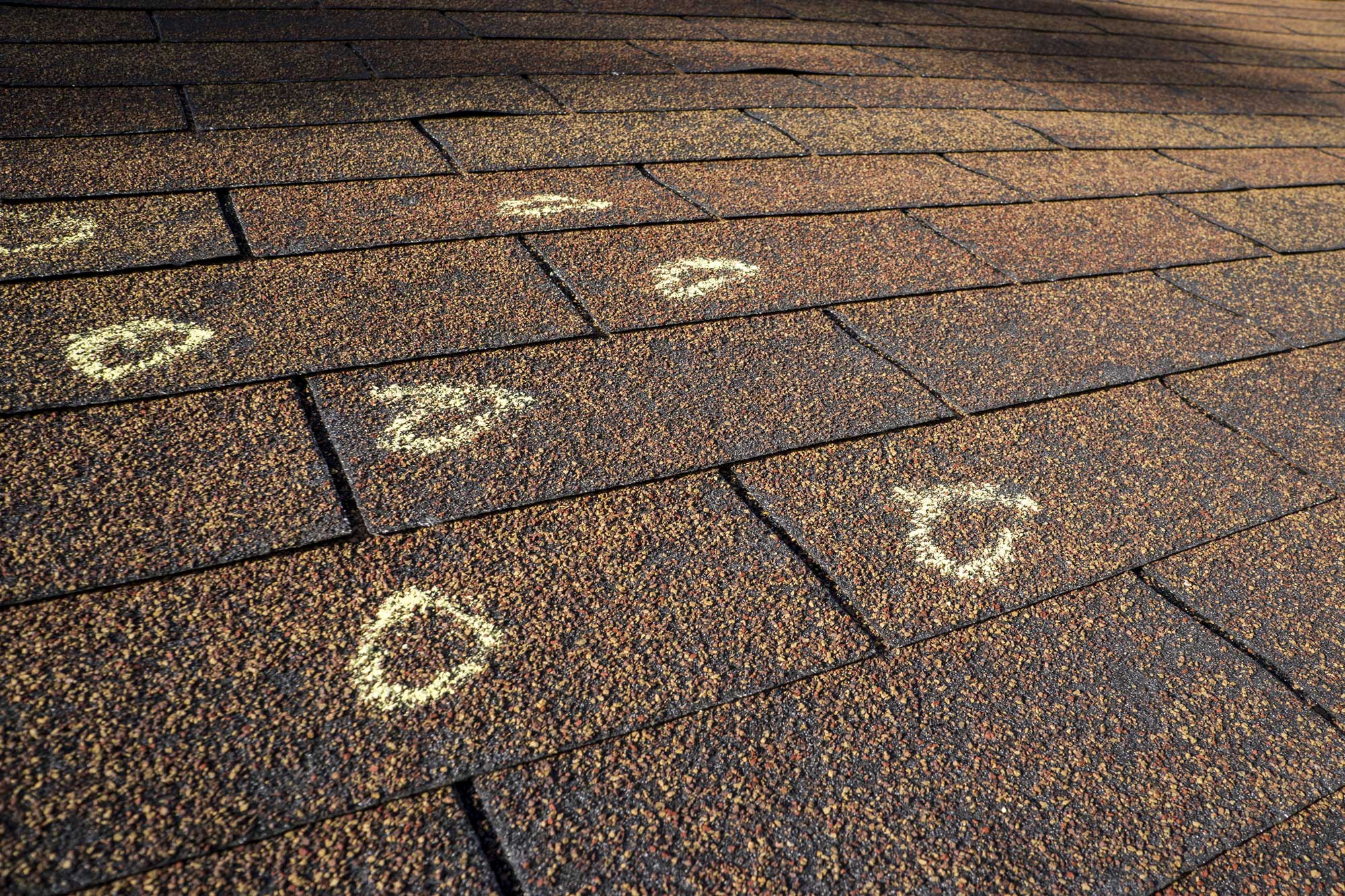
On asphalt shingles, hail impact creates what's called a bruise — a soft spot in the shingle where the granules have been knocked loose and the underlying mat has been exposed or weakened. From a distance, it might look like a dark spot or a slight depression. Up close, it looks like a circular area where the surface texture is gone and the substrate beneath is visible. That exposed area is no longer shedding water the way it should, and it's aging faster than the surrounding shingle from the moment of impact.
The easier-to-spot evidence is often on other surfaces:
- Gutters and downspouts with dents or dings from hail impact — if the hail was big enough to dent metal, it was big enough to damage shingles.
- Window screens with small circular tears or punctures from the same hail that hit your roof.
- AC condenser fins that are bent or dented on the top-facing surfaces.
- Painted wood surfaces like fascia or trim with small circular chips where hail knocked paint and wood fiber loose.
- Soft metal flashing on the roof surface — around chimneys, pipe boots, and valleys — with visible impact dents.
If you're seeing any of these on the peripheral surfaces of your home, your shingles took hits too. The question is how many and how severe.
How quickly should you act after a Houston hailstorm?
In a city where hail events are frequent and insurance claims are competitive, the clock starts running the moment the storm ends.
Speed matters after a hail event, and it matters for a few reasons that are specific to Houston's market. First, the practical one: a compromised shingle after hail has less protective capacity against the next rain, and Houston doesn't wait long between weather events. A roof that took hail hits on Tuesday and gets a thunderstorm on Friday is more vulnerable than it was before.
The second reason is insurance-related. Texas homeowner's insurance policies cover hail damage, but they have time limits and documentation requirements. Most policies have a one-year window from the date of loss to file a claim, but the documentation process — adjuster visit, inspection, contractor assessment — takes time. Starting that process early, while the damage is fresh and clearly attributable to the recent event, makes everything cleaner.
The third reason is contractor availability. After a significant hail event in the Houston metro, every roofing contractor in a three-state radius shows up for work. The reputable local ones book up fast. Getting on the schedule of a contractor you've vetted and trust is easier in the days after a storm than in the weeks after, when the good ones are already committed.
How do you tell a trustworthy Houston roofer from a storm chaser?
After every major hail event, out-of-town contractors flood the Houston market — here's how to tell who's actually worth hiring.
This is one of the most important questions a Houston homeowner can ask, because the answer directly affects whether your roof gets fixed properly or whether you end up with a bad installation, a voided warranty, and a contractor who's already three states away when the problems show up.
Here's what separates a legitimate Houston roofing contractor from a storm-chasing operation:
- They have a permanent local business address and have been operating in the Houston market before the storm hit.
- They carry a Texas contractor license, current general liability insurance, and workers' compensation coverage — and they'll provide documentation without hesitation.
- They don't pressure you to sign anything at the door or offer to waive your insurance deductible, which is insurance fraud under Texas law.
- They provide a written, itemized estimate that details materials, labor, warranty terms, and project timeline.
- They have verifiable local reviews on Google, the BBB, or similar platforms that predate the recent storm.
- They work with your insurance adjuster rather than trying to bypass the process or inflate the claim.
If a contractor shows up uninvited, pressures you to decide on the spot, or can't produce licensing and insurance documentation immediately, thank them for stopping by and close the door.
Lone Star Roofing Questions: Straight Answers for Houston Homeowners
Big Storm, Bigger Decision — Let's Get Your Roof Right the First Time.
Houston doesn't do anything small, and hailstorms are no exception. When the sky opens up and the ice starts flying, your roof is out there taking every hit so you don't have to. The least it deserves is a proper inspection afterward and honest repairs from people who know what they're doing and plan to be around when the next storm season rolls through.
If you're in Houston, TX and your roof just went through a hail event — or if you suspect it took damage in a storm that passed without much fanfare — reach out to Punum Roofing. They know Houston weather, they know Texas insurance claims, and they'll give you a straight read on what your roof needs without the pressure tactics or the out-of-town disappearing act.
Contact Punum Roofing today and let's make sure your home is ready for whatever the Gulf Coast sky has next on its agenda.
Recent Articles
Residential Roofing
Is Your Houston Roof Ready for Hurricane Season? Here's How to Prepare Before June
A roof inspection before the hurricane season starts can mean the difference between riding out a storm with confidence and making frantic calls after the damage is done.
March 25, 2026
.jpg)
Insurance Claims After a Storm: What Houston Homeowners Should Know Before Calling a Roofer
Houston homeowners’ guide to filing a storm roof damage insurance claim: what to do in the first 72 hours, how Texas claims work, and mistakes that can cost you coverage.
March 3, 2026
.jpg)
Why Houston Homeowners Are Switching to Aluminum and Steel Roofing
Discover why Houston homeowners are switching to aluminum and steel metal roofing for better durability, energy efficiency, and long-term protection against heat, hail, and Gulf Coast storms.
March 2, 2026
Houston Hail Damage 101: How to Spot and Fix Roofing Damage Fast
Houston’s frequent hailstorms can quietly damage your roof. Learn how to spot hail impact, act quickly for insurance, and choose a trustworthy local roofer for proper inspection and repairs.
March 1, 2026